




What Is a Ball Screw? A Complete Guide to Its Structure and Operating Principle
- Home
- Product Journal
- What Is a Ball Screw? A Complete Guide to Its Structure and Operating Principle
A ball screw is a high-efficiency precision mechanical drive component designed primarily to convert motor-driven rotary motion into linear motion. With its low friction, high transmission efficiency, high positioning accuracy, and high axial load capacity, ball screws are widely used in machine tools, semiconductor manufacturing equipment, industrial automation systems, robotics, medical equipment, aerospace systems, and precision measuring equipment.
Unlike conventional lead screws, which rely on sliding friction between the screw and nut, a ball screw uses steel balls that roll between the screw shaft and the ball nut. This rolling-contact mechanism replaces sliding contact, significantly reducing frictional resistance and energy loss.
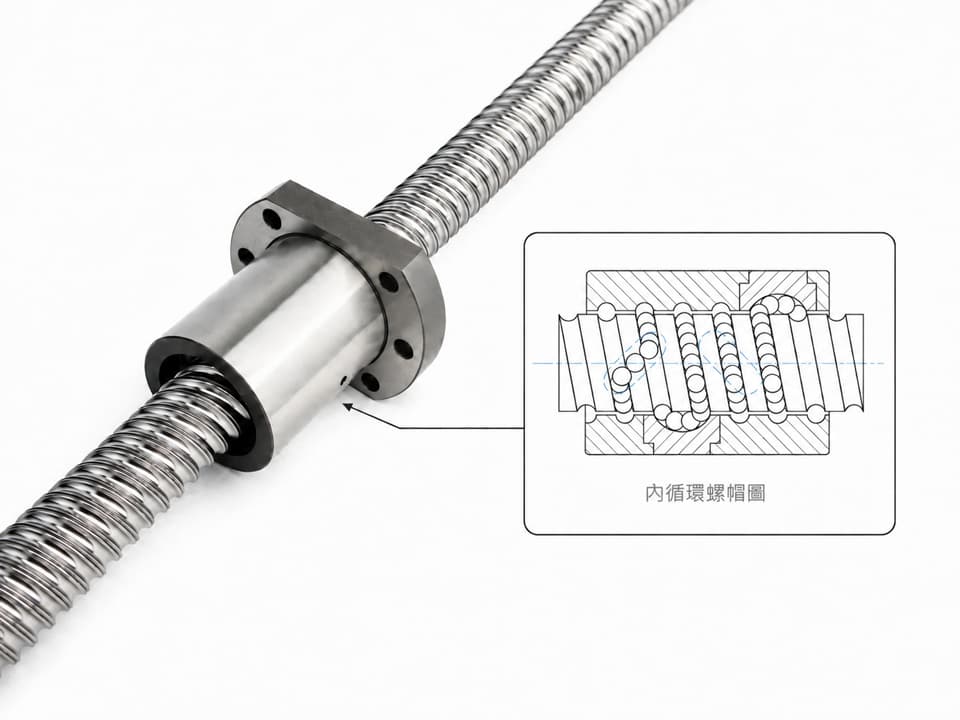
Main Components of a Ball Screw
A complete ball screw assembly typically consists of a screw shaft, a ball nut, steel balls, and a ball recirculation system.
The screw shaft is precision-machined with helical grooves, while the ball nut contains corresponding internal raceways. Steel balls are positioned between the screw shaft and the ball nut to transmit axial loads. When either the screw shaft or the ball nut rotates, the balls travel along the helical raceways.
To maintain continuous ball circulation, a recirculation mechanism is incorporated into the ball nut. After the balls reach the end of the load-carrying zone, they are redirected through the recirculation system and returned to the starting point, where they re-enter the loaded raceway. This closed-loop recirculation mechanism enables continuous ball movement and ensures smooth, stable linear motion.
How Does a Ball Screw Work?
A ball screw operates by using its helical raceways to convert rotary motion and torque into linear motion and axial thrust.
When a servo motor drives the screw shaft, the steel balls between the screw shaft and the ball nut roll along the helical raceways. If the ball nut is mechanically constrained from rotating, it moves linearly along the screw shaft. Conversely, when the screw shaft is held stationary, rotating the ball nut can also generate linear displacement.
Why Are Ball Screws Highly Efficient?
In a conventional lead screw, the screw and nut are in sliding contact, which generates relatively high friction, wear, and heat. In contrast, a ball screw transmits loads through the rolling motion of steel balls, significantly reducing friction between the contact surfaces.
Under proper lubrication, installation, and loading conditions, the mechanical efficiency of a ball screw can exceed 90%. This allows a relatively small amount of motor torque to generate substantial axial thrust. Lower friction also helps reduce heat generation, improve system responsiveness, and minimize energy loss during machine operation.
What Are the Advantages of Ball Screws?
The primary advantages of ball screws include high transmission efficiency, high positioning accuracy, low friction, reduced wear, excellent repeatability, and the ability to carry axial loads. By selecting the appropriate accuracy grade, lead, preload, and support configuration, ball screws can meet a wide range of machine design requirements, including high-speed travel, high rigidity, long strokes, and precision positioning.
Compared with hydraulic or pneumatic systems, a ball screw driven by a servo motor provides more precise control of speed, position, and thrust. It can also reduce issues associated with hydraulic oil leakage, compressed-air energy losses, and system maintenance. As a result, ball screws have become essential mechanical drive components in modern automation equipment, machine tools, semiconductor manufacturing equipment, and electromechanical actuator systems.
To deliver these performance advantages consistently in actual equipment, manufacturing accuracy, raceway profile control, recirculation system design, and quality management are equally critical.
GTEN specializes in the development and manufacture of high-precision ball screws. From raw material processing, screw shaft machining, heat treatment, grinding, and assembly to final inspection, GTEN maintains an integrated in-house manufacturing and quality-control process. Multiple in-process and final inspections are performed before shipment.
Through strict control of lead accuracy, raceway profile, preload, running torque, and product consistency, GTEN is committed to providing ball screw solutions with reliable accuracy, stability, and performance for precision drive applications in industrial automation, semiconductor equipment, machine tools, medical equipment, and aerospace systems.
How to Select the Right Ball Screw
Ball screw selection should not be based solely on the screw diameter and lead. Design engineers must also evaluate axial load, travel speed, acceleration, effective stroke, positioning accuracy, mounting configuration, required service life, critical speed, buckling load, and operating environment.
Lubrication, contamination protection, shaft-end machining accuracy, and installation alignment also have a direct impact on actual performance. Even when a high-precision ball screw is selected, improper installation—such as misalignment, insufficient parallelism, or an unsuitable support-bearing arrangement—can lead to abnormal wear, excessive heat generation, vibration, and premature failure.
Conclusion
A ball screw is more than a mechanical component that converts rotary motion into linear motion. It is a critical drive element that directly influences machine accuracy, speed, rigidity, efficiency, and service life.
Through precision-machined helical raceways, rolling ball contact, and a continuous recirculation system, a ball screw can transmit axial loads efficiently under low-friction conditions. This enables it to meet the requirements of modern automation and high-precision equipment for rapid travel and accurate positioning.
Proper product selection, installation, lubrication, and maintenance are essential to maximizing ball screw performance and extending its operating life.
